

When the Firewall Falls
How Europe’s mainstream traded conviction for convenience and opened the door to forces built on grievance, fear and political punishment.

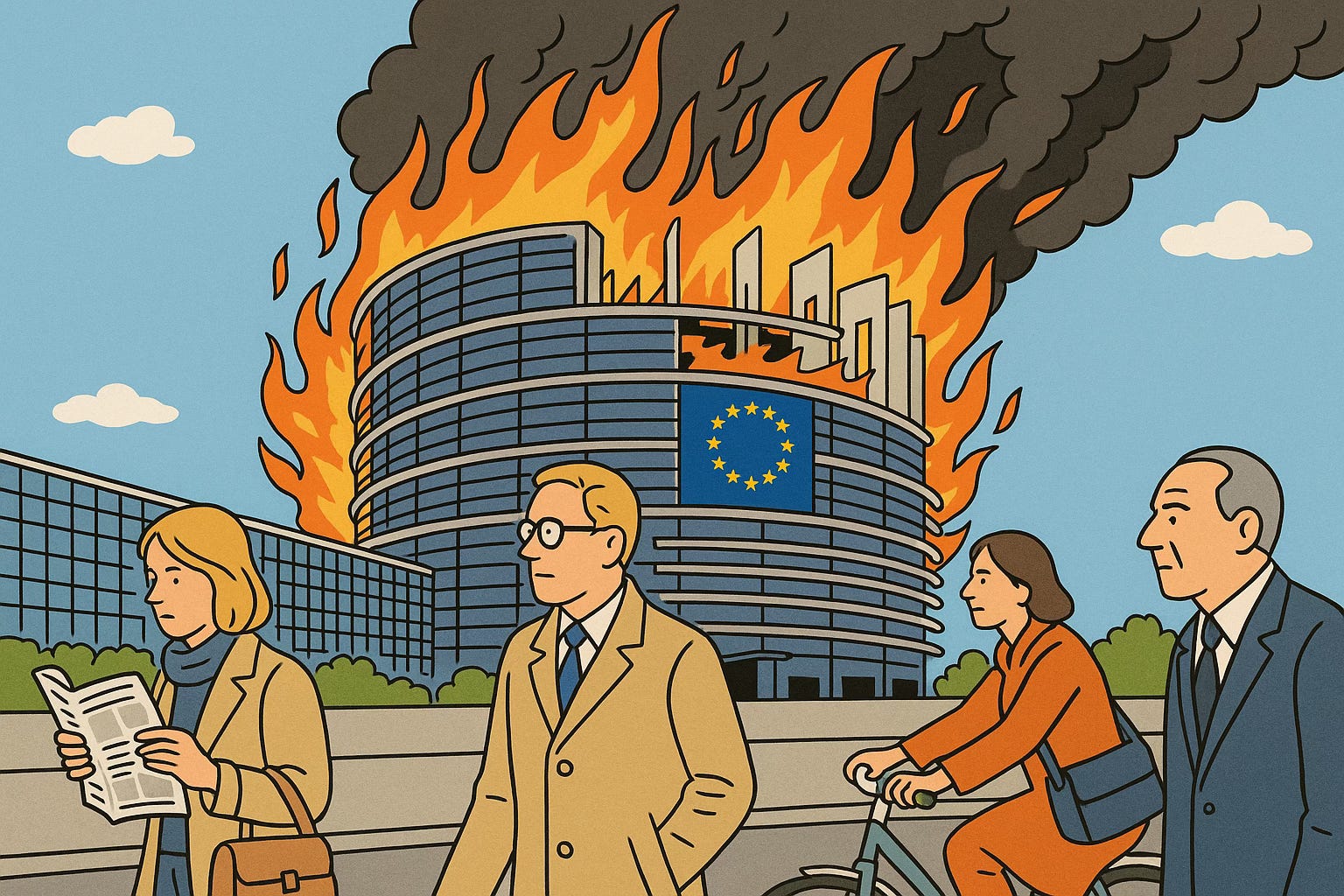
Europe’s political centre has long adhered to a simple rule: you do not rely on extremists to shape the future. Last week in Strasbourg, the rule quietly collapsed as the cordon sanitaire frayed not only in Brussels but also in Berlin and beyond; the far right no longer needs to win power to transform it. The real question now is whether the centre still remembers why the firewall existed in the first place.
By Mika Horelli
There are political turning points that arrive with a roar. And some slip in quietly, disguised as procedural votes or tedious committee manoeuvres, noticed only by the few who still pay attention to the architecture of power. What happened in Strasbourg last week belongs squarely to the second category. When the European Parliament’s centre-right EPP group reached for far-right support to weaken environmental legislation, Europe did not just witness a tactical choice. It watched a taboo dissolve.
The cordon sanitaire – that unwritten agreement that extremists are not legitimate partners in shaping Europe’s future – cracked, calmly and almost politely, in the middle of a weekday vote.
The significance of that moment is not contained in the legislation itself. It lies in what the gesture communicates: that cooperation with the far right is no longer unthinkable, no longer reputationally toxic, no longer something that must be ruled out before any negotiation even begins. It is the political equivalent of crossing a threshold and hearing the click behind you. Once the door shuts, no one pretends you are still standing on the safe side.
The far right understood the message before most commentators did. Within hours, their language shifted. They were no longer outsiders but necessary actors. Not fringe protest movements but parliamentary forces whose support could secure outcomes the mainstream could not achieve alone. And once the most prominent political family in Europe signals that extremists are “usable”, the psychological barrier that once defined European politics melts away. The first breach is always the hardest. The second arrives effortlessly.
This is not a phenomenon isolated to the European Parliament. What occurred in Strasbourg is part of a broader continental pattern that has been gathering force for years.
In France, Rassemblement National has moved from pariah to presidency-in-waiting, not because its programme has become more plausible but because the institutions built to contain it have lost their authority. In Italy, Giorgia Meloni governs not as a moderating conservative but as the embodiment of a new European right that seeks to reshape norms, rather than adapt to them.
In Scandinavia, the Sweden Democrats have managed to integrate themselves into the policymaking process, despite never shedding their extremist origins. Even in the Netherlands, a country long allergic to ideological drama, Geert Wilders’ ideas are now treated less as dangers than as inevitabilities.
And then there is Germany, where the cordon sanitaire is already fraying. Local and regional officials have begun to explore “technical cooperation” with the AfD, a euphemism for what is, in reality, the early stages of normalization. Court decisions, urgent public statements and party expulsions have tried to slow the erosion, yet the gravitational pull persists.
The firewall that Germans once described as ironclad now resembles something softer, something negotiable.
If Germany, a country that defined its postwar identity through the rejection of extremism, begins to drift, the rest of Europe will not hold its line.
What binds these developments together is not coordination but convergence. The far right has discovered a form of politics that thrives without governing competence and survives without policy coherence. It is not an ideology but an identity, a posture built on seeing enemies everywhere and claiming authenticity against a supposedly corrupt and weakened establishment. The internal logic of these movements is not to make but to blame, not to reform but to expose, not to reconcile but to punish.
This is where Timothy Snyder’s concept of sadopopulism becomes indispensable. These are movements that promise their supporters not a better life but the satisfaction of seeing someone else suffer.
