

The True Believers
From cognitive dissonance to Finnish communists to MAGA: a short history of why knowing is not enough

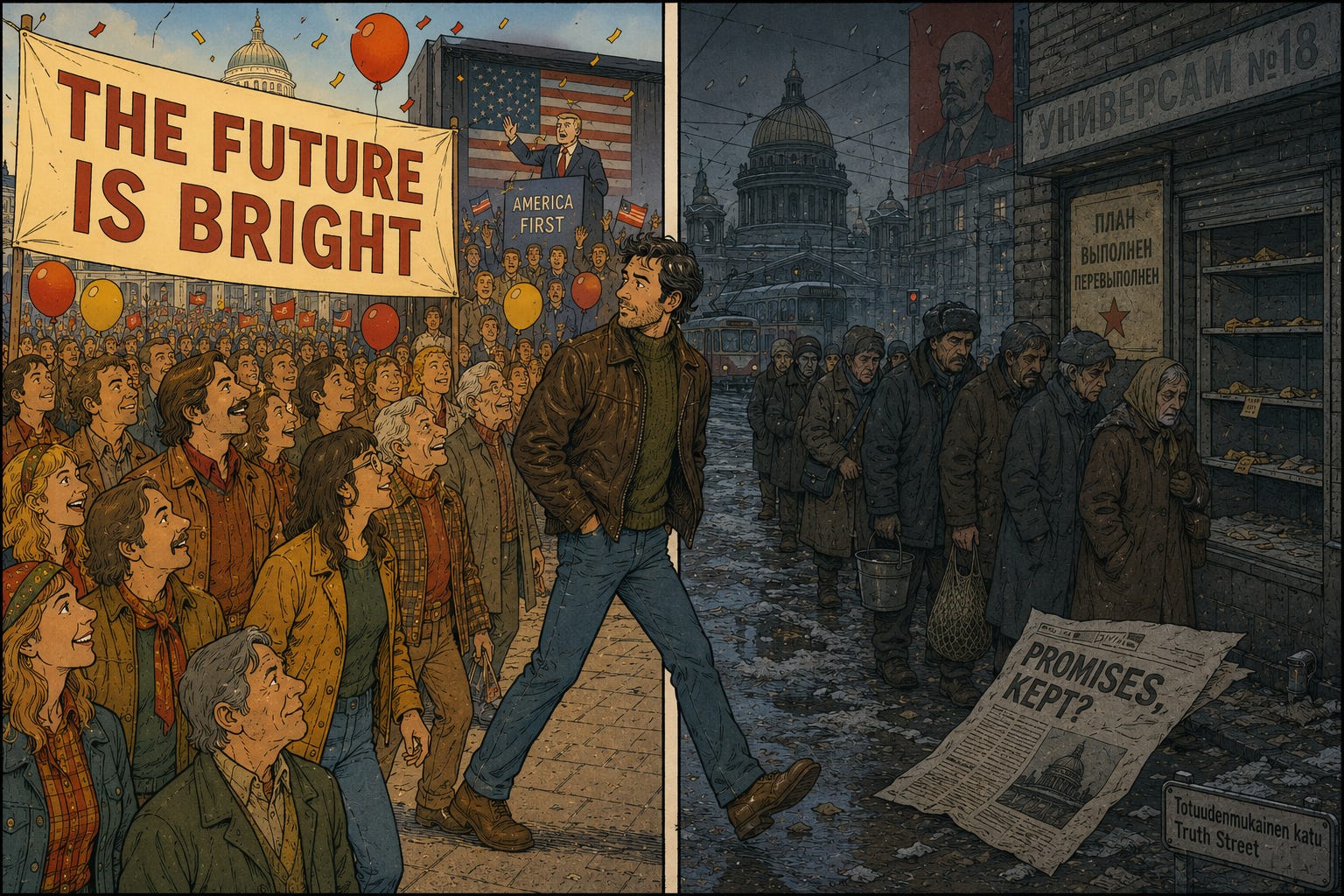
In 1949, six former communists tried to explain why they had spent years believing in a system they had ample evidence was rotten. The same question keeps resurfacing: in Finnish minority communists who travelled to the Soviet Union, saw the empty shelves, and believed anyway; in British Fabian intellectuals who praised Stalin’s new civilisation at the exact moment famine was killing millions; and in today’s MAGA movement, whose core has barely flinched even as the promised wars keep grinding on and prices keep rising instead of falling. This essay digs into the mechanism of cognitive dissonance and ends with an uncomfortable question: what do we ourselves believe right now, so firmly that we cannot yet see we are doing exactly the same thing?
By Mika Horelli, Brussels
Some people lie. They are easy enough to understand; lying can bring money, power, or at least a way out of trouble. Some people are simply wrong, because they do not know any better. They too are easy to understand.
Far harder to understand are the people who know, and believe anyway.
I mean people who have access to the same facts as the rest of us, who see the same contradictions, read the same news, sometimes even witness with their own eyes the very thing they are trying to explain away, and who end up defending their conviction more fiercely than before. They are not ignorant. That is precisely what makes the phenomenon so compelling.
Reality was not wrong. It simply needed to be reinterpreted.
In 1949, six former communists published a book called The God That Failed. Arthur Koestler, Ignazio Silone, André Gide, Richard Wright, Louis Fischer and Stephen Spender each tried, from their own angle, to answer the same question: how had it been possible for them to believe, for years, in a system whose falseness they had had ample evidence of the entire time?
Koestler’s answer was unsettling precisely because it was not political. In his view, joining communism resembled a religious conversion far more than a political decision. A person did not weigh the arguments for and against, as when choosing a washing machine; he found community, purpose, and an explanation for the world. That is exactly why leaving felt more like a crisis of faith than a change of opinion.
The idea is far more useful than it sounds on first reading. It explains something that otherwise looks almost irrational. Why does a person defend a conviction he knows is leaking at every seam? Why is an intelligent person capable of building ever more sophisticated explanations for contradictions that are obvious to everyone else, when the far simpler option would be to admit he was wrong?
We are not talking here about people who lived under Stalin, or under other dictatorships; they often had to feign belief simply to survive. That was not conviction; it was a survival strategy. Far more interesting are those who lived in free societies, under no obligation to believe anything at all, and who chose to do so voluntarily.
A Finnish example
Finland offers a useful case. After the war, the Finnish communist movement gradually split into two separate realities. One faction began openly criticising the Soviet Union by the 1960s at the latest. The other, a minority later known as the taistolaiset, moved in exactly the opposite direction. Precisely as the evidence of the system’s failure accumulated year after year, their faith appeared to grow stronger. (The label “taistolainen” comes from Taisto Sinisalo, the faction's leader; it stuck to the movement as a whole, the way such nicknames often do.)
This is what makes the phenomenon so striking. They did not live in Leningrad; they lived in Helsinki. They did not read only Pravda; they also read Helsingin Sanomat, Dagens Nyheter, Le Monde, and any Western newspaper they wished. They travelled, they argued, they saw with their own eyes far more than an ordinary Soviet citizen ever could.
Many of them travelled to the Soviet Union itself. There they saw the empty shelves, the endless queues, people’s caution, the scarcity of everyday life. None of this was an invention of Western propaganda; it was something anyone could observe firsthand. And yet they came home convinced that the socialist future was bright.
The one thing the Soviet Union never ran short of was evidence of the system’s failure. And yet it was precisely that evidence which travelled home in the fewest suitcases.
Evidence that never made the trip home
The same pattern showed up even more clearly across Western Europe. The French and Italian communist parties drew in writers, professors, artists and trade union leaders whose intelligence no one doubted. They travelled to Moscow, saw what everyone else saw, and came home to write glowing accounts of their journey.
A particularly striking case was that of the British social reformers Sidney and Beatrice Webb. They were among the most respected figures of the Fabian Society, hardly naive idealists. In 1935 they published a substantial book portraying the Soviet Union as a new and superior civilisation. That same year, millions had just starved to death in Ukraine, Stalin’s purges were underway, and the network of forced labour camps was expanding rapidly.
The information was there. The problem was never a lack of knowledge; it was that knowledge was no longer allowed to influence the conclusion.
A liar knows he is lying. A believer does not necessarily experience himself as lying at all.
When the flying saucer never came
The more deeply belief is fused with identity, the harder it becomes to admit having been wrong. In the 1950s, the social psychologist Leon Festinger did something researchers rarely do. Instead of asking people for their opinions in a survey, he observed what they actually did when their entire worldview collapsed.
He followed a small American doomsday cult convinced the world would end on a specific night. Salvation had already been arranged; a flying saucer would collect the true believers to safety just before the catastrophe struck.
Night came. No flying saucer came. The world did not end.
If people behaved rationally, the group should have dissolved on the spot. It did not; quite the opposite happened. Many members began proclaiming their faith more loudly than before. An explanation arrived quickly: the world had been saved precisely because of their unwavering belief.
Reality had changed. So the explanation changed with it.
Festinger gave the phenomenon a name that became one of the best-known concepts in social psychology: cognitive dissonance. When facts and a person’s worldview collide violently, that person rarely changes the worldview. Instead, he starts changing what the facts are allowed to mean.
The more of one’s own life one has invested in a cause, the more expensive it becomes to admit having been wrong. This is no longer a matter of opinion; it is a matter of identity. If I have built my entire youth around a movement, admitting I was wrong does not stop at that; I must also ask myself whether I spent decades of my life on a delusion. That is a far heavier price than losing a single argument.
The twelve-year-old candidate
I recognise the mechanism uncomfortably closely, even though I was never a communist.
In the early 1970s, Finland’s school reform introduced so-called school councils, meant to teach democracy in practice. I was twelve when I was asked to stand as the minority communists’ candidate in the school council election.
There was only one small problem: I knew practically nothing about politics. I could not have named all the parliamentary parties, I had no idea about the internal splits within the communist movement, and I certainly could not have explained what minority communism actually meant. And yet I very nearly agreed to run; not because I was gripped by Marxism, but because someone had asked.
Fortunately, one of my teachers found the idea troubling. He rang my parents and gently suggested that the boy might benefit from learning something about the Finnish party system before representing one of its edges.
At home, I received my first-ever lesson in politics. My parents did not try to tell me what to think. They simply said the decision was mine to make, but that it would help to know, at least roughly, whose banner I was about to stand under.
I withdrew my candidacy. A year later I ran again, this time as an independent. And I was elected.
That episode proves nothing large about Finnish political history. But it points to something far more ordinary. People often join a group long before they understand its ideas. First comes the feeling of belonging; the beliefs tend to arrive later.
This order, incidentally, is not confined to twelve-year-olds. It appears to follow many adults throughout life as well.
Few people join a movement for its facts. Far more people adopt the facts only after joining the movement.
MAGA: two realities running in parallel
Had Festinger lived in the age of social media, he would hardly have needed to go looking for a small doomsday cult to study. Today, the same phenomenon is visible on a phone screen daily.
The best-known example of this decade comes from the United States.
Donald Trump promised to end the war in Ukraine within twenty-four hours. The promise was spectacular enough that it could never later be waved away as a misunderstood detail. He also promised to lower the cost of living for Americans, rapidly bring manufacturing back home, and keep the United States out of new wars.
Reality moved in the opposite direction. The war did not end in a day, nor in months. The Iran crisis expanded America’s military role in the Middle East once again. Import tariffs drove up prices on exactly the goods meant to make ordinary life cheaper.
In a normal political world, this combination would be straightforward: promises were made, they were not kept, and support falls.
That is what happened, but only in part.
Trump’s overall approval rating weakened in nearly every poll throughout the spring and summer of 2026. What was more interesting was what happened among his most loyal supporters. Their support fell too. Just far less.
It was as if two separate realities had been running side by side. The more outsiders noticed the contradictions, the more the core focused on explaining why the contradictions were not really contradictions at all.
Tribe before fact
This is not an American peculiarity. It is not, in the end, even a political peculiarity. The same mechanism shows up in religious sects, revolutionary movements, conspiracy theories, sports fandom, and sometimes even corporate life. Once belonging to a group becomes part of one’s identity, facts stop functioning as judges. They turn into weapons for the other side.
That is exactly the point at which conversation becomes nearly impossible.
If I argue with someone about a tax rate, we can both still change our minds once better numbers appear. But if the argument is really about what kind of person I am, new numbers become a threat. Every counter-argument no longer sounds like information; it sounds like an attack on one’s own tribe.
When opinion becomes identity, facts become insults.
This is why it is usually a mistake to assume the most loyal supporters are simply ignorant. Quite the opposite: many of them know the opposing arguments remarkably well. They have read them, listened to them, and spent years developing ever more sophisticated ways of explaining why none of it really matters.
Koestler understood this decades ago. He did not write The God That Failed because he had been stupid as a young man; he wrote it because he had been intelligent. It was precisely that intelligence which had made him so skilled at defending a belief he was not yet ready to let go of.
Perhaps that is the most ironic lesson of the phenomenon as a whole. Propaganda rarely thrives where people know least. It thrives where people have the most to lose by admitting they know too much.
The Finland that spoke in code, and the difference everyone forgets
I grew up in what later came to be called Cold War Finland, a country that spoke about the Soviet Union in its own particular code. Every adult understood that not everything was said aloud; the president’s foreign policy was supported, phrases were carefully weighed, and one lived cautiously around the eastern relationship.
But there is one important distinction that keeps getting lost in today’s debate. Most Finns did not actually believe the Soviet Union was a workers’ paradise. They simply judged it unwise to say everything they thought. It was realism, sometimes opportunism, but rarely anything resembling religious conviction.
That is exactly what made the taistolaiset such an interesting case. They were not built on silence; they were built on belief. One group adapted itself to reality. The other adapted reality to its belief. The difference sounds small. Psychologically, it is enormous.
The memoirs that do not yet exist
In recent years I have read the memoirs of several former Finnish minority communists. There is something surprisingly moving in them. Few of them still try to insist they were right; far more of them are trying to understand their own youth. Many of them share the same astonishment: how could I have believed that?
It is an honest question. But it is also, in a way, slightly misleading. Perhaps the real question is not how they could have believed it. The real question is what we ourselves believe right now, so strongly that we cannot yet see we are doing exactly the same thing.
Every generation recognises the delusions of the one before it far more easily than its own. Koestler’s generation wrote The God That Failed only once the faith had already broken. The former members of taistolaiset wrote their memoirs only decades later.
Perhaps one day we will read books written by people who explain, just as openly, why they believed in Donald Trump, in QAnon, in some revolution of our own time, or in a cause we cannot yet even name. Their explanations will probably sound familiar. They will not say they were stupid. They will say they were looking for community, for purpose, and for the feeling of standing on the right side of history.
Perhaps that is this essay’s most uncomfortable conclusion. We like to think of ourselves as rational people who update our opinions whenever the facts change. In practice we do this far less often than we imagine. Usually we first change how we interpret the facts, and only much later, sometimes only after decades, do we dare ask ourselves whether we might have been wrong.
Koestler understood this better than most politicians or psychologists ever have. His insight was not that people are ignorant. It was far darker than that: a person can know almost everything, and believe anyway.
That is why the most dangerous person is not necessarily the one who does not know. It is the one who knows enough to notice the contradiction, but whose identity no longer allows him to admit it.
Perhaps that is exactly why every generation remains convinced it will never fall for the delusions the previous one now laughs about in its memoirs.
And perhaps that is exactly why every generation, sooner or later, ends up writing its own version of The God That Failed.
Only ever afterwards.
About the author
Mika Horelli is a Finnish foreign correspondent based in Brussels. Since 1996, he has reported on European politics, international affairs and emerging technologies from Copenhagen, New York and Brussels. His work combines on-the-ground reporting with historical context, focusing on geopolitics, democracy, artificial intelligence and the long-term forces reshaping Europe and the wider world.
About Nordic Ledger
Nordic Ledger is an independent publication dedicated to thoughtful, long-form journalism on geopolitics, technology and society. Rather than chasing the daily news cycle, it examines the deeper trends, historical context and strategic choices that shape tomorrow’s headlines.
New essays are published regularly and delivered directly to subscribers’ inboxes.
Written for readers who prefer depth to speed.