

The Kill Switch
Washington is not just an unreliable partner. It has become a structural threat to European sovereignty.

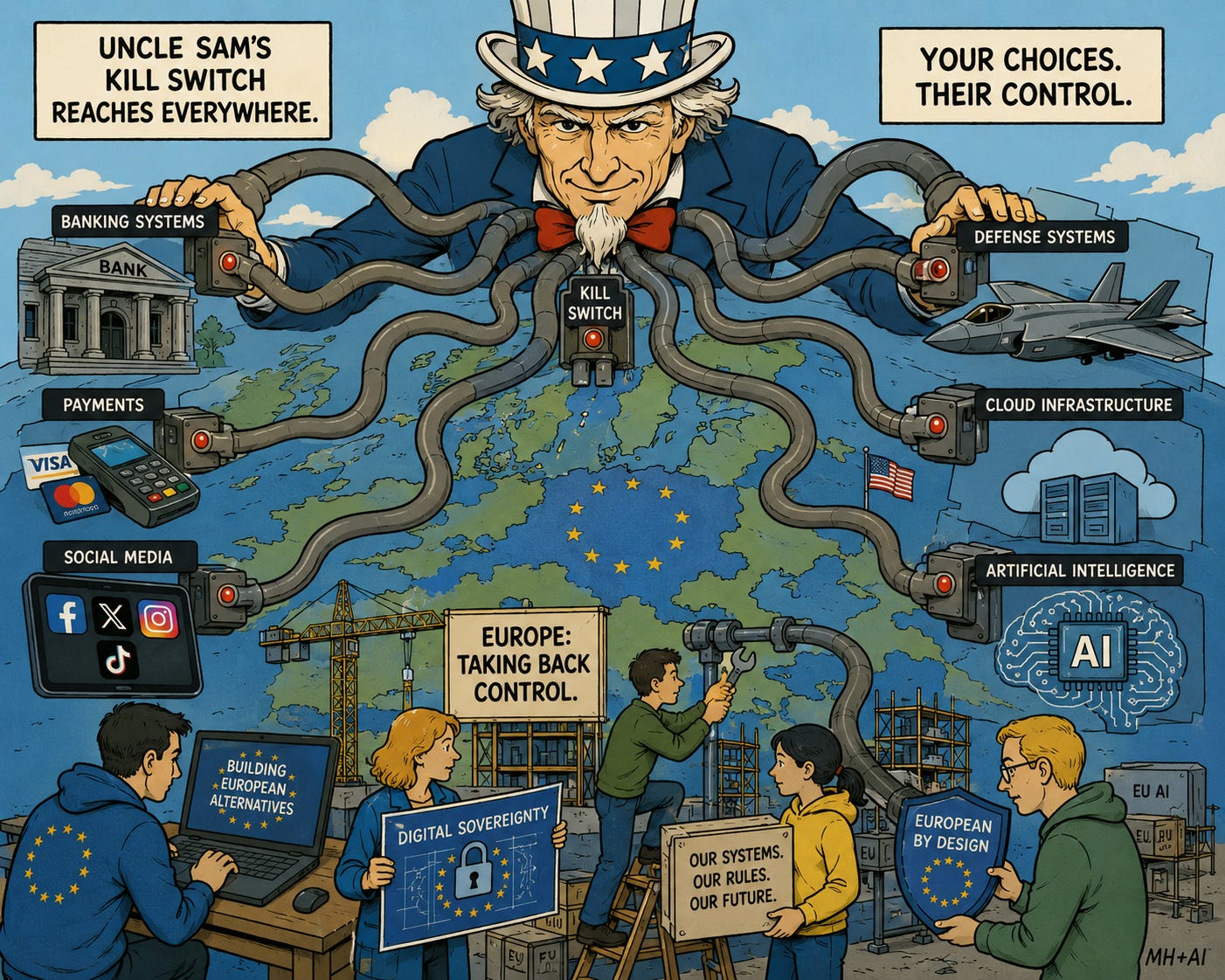
On a Friday afternoon in June 2026, Washington locked Europeans out of some of the world’s most advanced AI tools. Access remains suspended. No timeline has been given. It was not the first time the United States has used its technological dominance as a lever against its own allies, and it will not be the last. This column argues that Europe has run out of time to treat dependency as an acceptable condition.
By Mika Horelli, Brussels
Last Friday, the United States Commerce Department ordered Anthropic to cut non-American users’ access to its most advanced AI models. Anthropic suspended access for everyone. Within hours, researchers, journalists, civil servants and businesses found themselves locked out of tools they had planned their workflows around, not because of anything Europe had done, but because Washington had decided to pull the plug.
Europe got the message. For the first time, the United States had used a commercial technology company as a coercive instrument against its own allies.
The kill switch, long theorised as a hypothetical risk, had been activated. And Europe, blinking in the sudden darkness, had no alternative ready.
This is the column I did not want to write. I have spent three decades covering American and European affairs and transatlantic relations. I have watched American administrations of every stripe, some more helpful than others, some more irritating than others, but all operating within a shared framework of rules, institutions and mutual interest. That framework is now being dismantled, deliberately and with apparent satisfaction, by the government of the world’s most powerful democracy.
What we are watching is not a temporary aberration. It is a pattern. And before I describe that pattern, I should confess something about the conditions under which I am describing it.
A confession from Brussels
I am writing this column on an Apple MacBook. I will publish it on Substack, an American platform. I use American language tools to refine my prose. I store my files in an American cloud. The AI model I use to assist my research is American. I am, in other words, a European journalist who criticises American technological hegemony using American technological hegemony as his primary instrument. The irony is not lost on me.
I know exactly how difficult it is to escape the gravitational pull of Silicon Valley, because I have not escaped it myself. Every tool I reach for in my daily work comes from California. The convenience is genuine. The dependency is genuine. And the vulnerability is genuine.
There is something else I know. If I were a more prominent writer, if this column reached a larger audience and my criticism of the current American administration were more visible, I could find myself sanctioned. My accounts suspended. My access revoked, not by any European authority, not under any European law, but by the decision of an American company responding to pressure from an American government. It would be entirely legal under American law. It would be entirely beyond my reach to contest.
For that not to be possible, I would need a European MacBook, a European publishing platform, a European cloud, European AI tools. None of those exists today at the scale and quality required.
That is precisely the problem Europe has to solve, not for ideological reasons, but for the most practical reason imaginable: because the alternative is accepting permanent vulnerability to the decisions of whoever happens to be running Washington at any given moment.
A pattern, not an accident
Consider what Washington has done to its European partners over the past few years. It sanctioned Thierry Breton, then the European Union’s Internal Market Commissioner, effectively blacklisting a senior official of an allied institution.
It imposed sanctions on International Criminal Court personnel, cutting them off from American banking and technology services, and punished lawyers and investigators for doing the job the international community created them to do. It has used the extraterritorial reach of American financial sanctions to pressure European banks into closing accounts and cutting off clients that Washington dislikes, regardless of whether those clients have violated any European law. And now it has demonstrated, in the Anthropic case, that it is willing to treat access to advanced technology as a geopolitical weapon to be switched on and off at will.
None of this is random. It reflects a coherent, if brutal, worldview: that the United States no longer has allies, only vassals and adversaries.
Countries are either subordinate to American interests or treated as problems to be managed. The old postwar model, in which Washington accepted constraints on its own power in exchange for a durable, rules-based international order, has been abandoned. What remains is raw leverage, applied without sentimentality.
The European response has been a mixture of alarm, indignation and diplomatic hedging. European Commission spokesperson Thomas Regnier said the Anthropic case “further underlines Europe’s need for technological sovereignty.” Finnish MEP Aura Salla called for Europe to “reserve our data and our market primarily for European tech.” The words are right. In practice, the urgency has been insufficient.
The dependency is deeper than we admit
Europe’s vulnerability is not limited to artificial intelligence. It runs through virtually every layer of the modern economy and the modern state.
Financial infrastructure: American payment networks process the overwhelming majority of European card transactions. SWIFT, though nominally international, operates under strong American influence and has been weaponised before, most dramatically against Iran. The digital euro project exists precisely because European policymakers understand this exposure, but it remains years from meaningful deployment.
Technology and cloud: European governments, militaries, hospitals and universities store vast quantities of sensitive data on servers operated by American companies subject to American law, including the CLOUD Act, which allows American authorities to demand access to data held abroad.
The European GAIA-X cloud initiative has struggled to gain traction against the scale and convenience of American hyperscalers. The gap between ambition and reality remains embarrassingly wide.
Defence systems: Finland, like many European NATO members, has committed to purchasing American F-35 fighter jets. These aircraft depend on American software, American maintenance contracts and, critically, American authorisation to operate certain systems.
The question that has been whispered in defence ministries across Europe and is now being asked more loudly is whether those aircraft would function if Washington decided, for whatever reason, to withdraw cooperation. It is not a paranoid question. It is a procurement question that should have been asked more rigorously years ago.
The Franco-German FCAS programme existed partly as an answer to it. Earlier this month, after years of industrial disputes between Airbus and Dassault that neither Paris nor Berlin could resolve, the project was formally abandoned. Europe’s most ambitious attempt to build a sovereign next-generation fighter jet is now history.
The Anthropic episode arrived, with unfortunate timing, as a reminder of what dependency looks like when the partner on the other end stops feeling charitable.
The uncomfortable truth is that Europe spent the postwar decades building deep dependencies on American systems on the reasonable assumption that Washington would remain a good-faith partner. That assumption has been tested and found fragile. One election produced an administration that treats these dependencies as leverage rather than as the foundation of an alliance.
The vassal problem
There is a concept in international relations that describes what happens to a country dependent on a more powerful patron without meaningful reciprocity: it becomes a vassal. Vassals are not allies. They are not partners. They are subordinates whose interests are considered only to the extent that they align with the patron’s.
Russia has been operating on this model for years. Its neighbourhood consists entirely of vassals or adversaries: countries that do what Moscow demands or are treated as threats. There are no genuine Russian allies, only states in various degrees of submission.
Russia, which once styled itself a great power with its own sphere of influence, has spent the years since 2022 methodically dismantling that pretension. Cut off from Western markets, dependent on Chinese purchases of its sanctioned oil, and reliant on Beijing’s tacit political cover at the United Nations, Moscow has drifted into a relationship with China that bears less resemblance to a partnership between equals than to a client state arrangement. A country of 140 million people has made itself structurally dependent on a country of 1.4 billion. Russia did not fall into this position. It chose it, one sanction-evading transaction at a time, until the choice became irreversible.
The trajectory of American foreign policy under the current administration points in a disturbingly similar direction. Washington’s relationships are increasingly transactional, coercive and zero-sum. NATO allies are shaken down for defence contributions framed as protection payments.
Trade partners are subjected to tariffs deployed as negotiating weapons. International institutions are treated as obstacles or irrelevancies. The EU-US trade deal reportedly reached last summer was negotiated under duress and on terms that many European trade analysts regard as asymmetric at best. Europe pays tariffs on American goods. America does not reciprocate. This is not a partnership. It is an arrangement.
This does not mean the United States is equivalent to Russia. It is not. American institutions retain depth and resilience that Russian ones do not. American civil society, courts and press remain significant counterweights. But the direction of travel matters. And Russia, it is worth remembering, was also once described as a country that Europe could do business with.
Decoupling without breaking
What Europe needs is not a rupture with the United States. It is independence of action: the capacity to cooperate with Washington when cooperation serves European interests, and to resist American pressure when it does not, without being vulnerable to economic or technological coercion.
This means building European alternatives across every domain where dependencies are acute.
A genuinely European payment infrastructure. Accelerated deployment of the digital euro. A serious European cloud capability with genuine data sovereignty. Investment in European frontier AI: France’s Mistral, currently raising three billion euros at a twenty billion euro valuation, is the most credible candidate, and it needs the kind of political and regulatory support that American tech giants received in their formative years through defence contracts and government procurement. A Buy European Tech framework that gives European companies preferential access to public contracts is not protectionism. It is the same industrial logic that built Silicon Valley.
European banks should also be examining their exposure to American financial infrastructure, seriously and urgently. Washington's ability to pressure any European bank into compliance through the threat of dollar-clearing sanctions is not a theoretical risk. It has happened repeatedly. The digital euro is one partial answer. European interbank infrastructure is another. Neither is a quick fix. But the time to begin is not after the next crisis.
None of this eliminates the value of American partnership when that partnership is offered in good faith. Europe is not trying to build a world without the United States. It is trying to build a world in which it can survive and function regardless of what Washington decides on any given Friday afternoon.
The moment of clarity
For years, the phrase “strategic autonomy” was treated in European policy circles with a mixture of French enthusiasm and Anglo-Saxon suspicion. It sounded like a Gaullist fantasy, a bureaucratic slogan designed to irritate Washington while achieving nothing in particular. It is now an existential necessity dressed in embarrassingly modest clothes.
The Anthropic kill switch is not a minor event that came and went. As of this writing, access to Fable 5 and Mythos 5 remains suspended for non-American users, with no restoration timeline in sight. European researchers, businesses and civil servants locked out on the afternoon of 12 June 2026 are still locked out.
This is not a temporary inconvenience that the market absorbed and moved on from. It is an ongoing demonstration of what American technological dominance means in practice when wielded by an administration that does not consider European interests worth protecting. The kill switch was not a warning shot. It is the current state of affairs.
Every time Washington blacklists a European commissioner, sanctions an international court’s staff or locks European users out of an AI model, it is showing Europe something important: that the infrastructure of modern life, the platforms, the payment systems, the cloud services, the defence software, can be turned into instruments of coercion at a moment’s notice, by a government that has decided allies are a category that no longer exists.
Europe has been given a warning. The question is whether it will act on it before the next demonstration involves something that cannot be restored with a policy reversal: a defence system that fails to function, a financial network that goes dark, a critical infrastructure dependency that becomes a crisis rather than an inconvenience.
I will keep writing this column on my American laptop, publishing it on my American platform, and backing it up to my American cloud. For now, I have no alternative. That is precisely the point. Europe needs to build one.
If you made it this far, thank you. This column is exceptionally available to all readers. If it was worth your time, it may be worth someone else’s too. Every new reader is a reason to keep writing. If you would like to read columns like this every week, consider subscribing.
Europe is at a historical crossroads that demands a profound redefinition of its identity and its functioning as a bloc. To achieve true unity, it is essential to advance toward genuine fiscal integration, which would allow for a cohesive and efficient economic policy, leaving behind the current fragmentations that weaken the Union.
One of the pillars of this refoundation must, without a doubt, be joint defense. Currently, Europe possesses the second-highest military budget in the world, surpassing China and placing itself only behind the United States. However, this immense investment is seriously undermined by alarming structural inefficiency. At present, we maintain 27 independent production and procurement lines, often disconnected from one another.
This lack of interoperability is the clearest symptom of the problem: we operate as isolated nations instead of as a united army. It is unacceptable that the parts of German tanks are not compatible with those of French, Italian, or any other member state. This redundancy not only wastes vital economic resources but also compromises our strategic response capacity in the face of global threats. Building an authentic "Europe of Defense" must necessarily involve a unified, standardized defense industry oriented toward collective efficiency.