

The Accountability Illusion
The Art of Forgetting

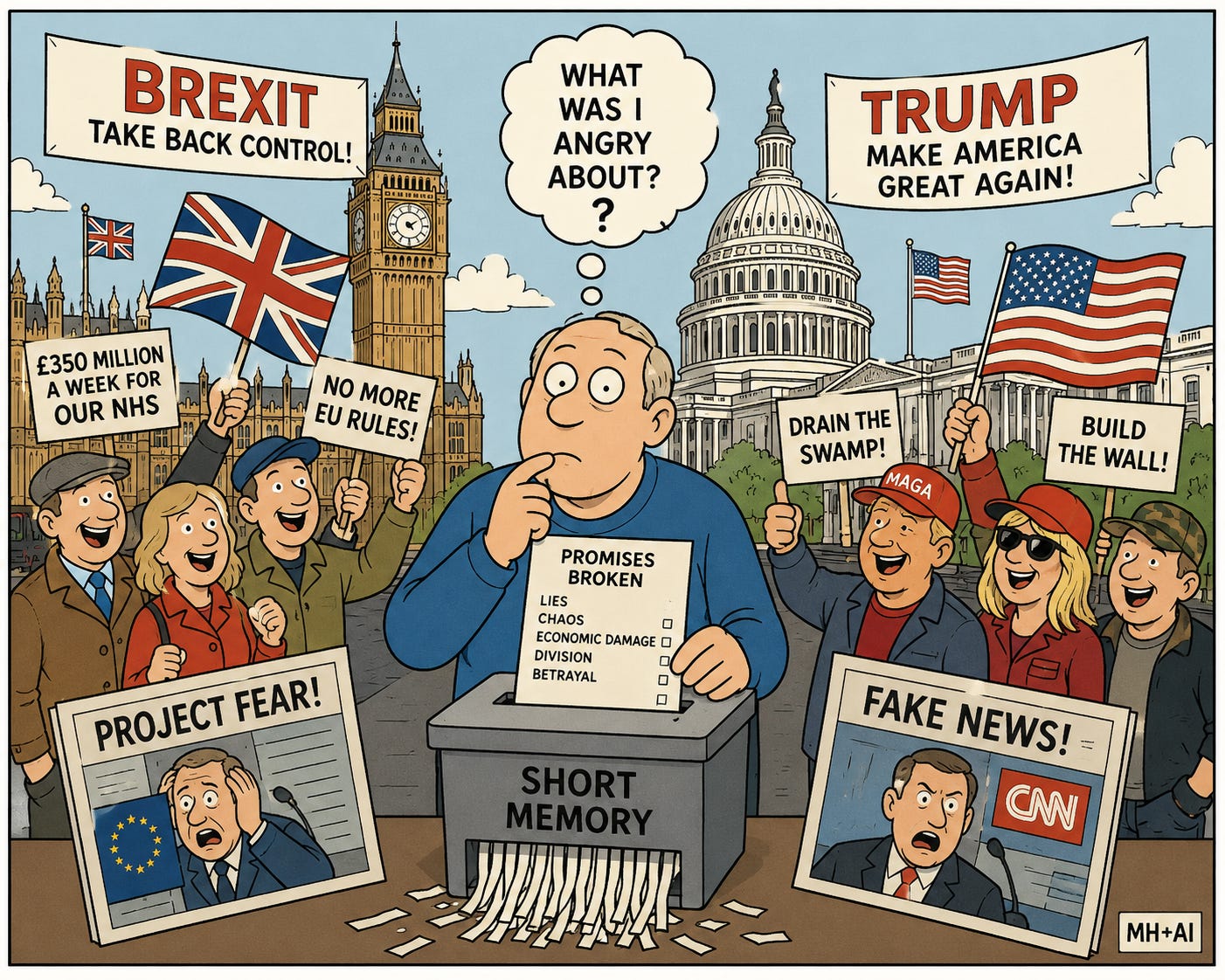
Democracy is supposed to punish failure. Elections are meant to remove leaders who damage their countries, lie to voters, or govern disastrously. Yet modern politics increasingly suggests the opposite. The architects of Brexit remain influential in Britain, Donald Trump returned to the White House after years of scandal and chaos, and the son of a former dictator now governs the Philippines.
This is not simply a story about populism. It is a story about memory. As media fragments into ideological tribes and politics becomes a form of identity, voters no longer judge leaders primarily by outcomes. They judge them by belonging. The consequences for democratic accountability are becoming impossible to ignore.
By Mika Horelli, Brussels
This year marks ten years since the Brexit referendum. When Britain voted to leave the European Union in June 2016, much of Europe reacted with the kind of disbelief normally associated with financial crashes or royal scandals. Nobody quite understood whether they were witnessing a temporary political psychosis or the beginning of something larger.
I moved to Brussels as a freelance journalist in 2017, directly into the aftermath of that decision. During the years that followed, I wrote hundreds of articles about Brexit, European politics, trade negotiations, border disputes, British identity crises, and the strange theatre of Westminster, trying to explain to itself what exactly it had done.
One conclusion gradually became unavoidable. Brexit was not Britain’s liberation story. It was one of the most expensive acts of democratic self-harm in modern European history.
This is no longer particularly controversial outside Britain’s more ideological political circles. By 2025, several major economic studies estimated that the British economy had become between 6 and 8 per cent smaller than it would likely have been without Brexit. Investment levels suffered. Small exporters abandoned EU markets under the weight of paperwork and customs bureaucracy. Labour shortages hit sectors ranging from logistics to agriculture to hospitality.
Britain’s fishing industry became an especially dark little comedy inside the larger tragedy.
Fishing communities overwhelmingly supported Brexit. For years, they had been told that liberation from Brussels would restore sovereignty over British waters and revive coastal economies. Instead, many found themselves trapped in export chaos, health certification requirements, transport delays, and collapsing access to European markets. Fish, unfortunately, has little interest in patriotic symbolism while waiting in customs queues.
The deeper irony was always obvious from Brussels.
Britain’s most valuable export was never simply fish, steel, or financial services. Its greatest strategic advantage was access to the English-language European single market. London functioned as America’s gateway to Europe, Asia’s gateway to Europe, and often the world’s gateway to Europe. Once Britain voluntarily abandoned that role, multinational companies quietly began relocating operations elsewhere inside the EU.
This should not have surprised anyone. Yet somehow it did.
And still, remarkably, the political architects of Brexit survived perfectly well.
Nigel Farage remains one of Britain’s most influential political figures in 2026. His Reform UK movement continues attracting frustrated voters from both Labour and the Conservatives. Boris Johnson still retains a strange celebrity aura despite leaving behind political chaos, scandals, and substantial economic damage that will occupy historians for decades.
This is where the story stops being about Britain alone.
Democracy is built upon a rather optimistic assumption about human behaviour: voters remember what politicians do. The entire system depends on this. Elections only function as accountability mechanisms if citizens connect political decisions to political consequences.
Increasingly, that connection appears dangerously weak.
In the United States, Donald Trump returned to the presidency despite impeachment proceedings, criminal investigations, endless scandals, and a first administration that often resembled an online argument accidentally placed in charge of a superpower. His approval ratings fluctuate constantly, yet his core support remains astonishingly durable.
Many Europeans still struggle to understand this because they continue analysing Trump as if he were a conventional politician.
He is not. For millions of supporters, Trump functions less as a political leader than as a cultural identity. Supporting him is not primarily about tariffs, taxation, foreign policy, or even economic outcomes. It is about belonging to a tribe that sees itself at war with liberal elites, institutions, universities, media organisations, and increasingly with reality itself.
Once politics becomes identity, factual contradictions lose much of their power.
This is not uniquely American. It has become one of the defining features of democratic politics across much of the world.
In the Philippines, Ferdinand Marcos Jr. became president despite his father’s dictatorship remaining synonymous with corruption, repression, torture, and the theft of billions in public wealth. Only a few decades earlier, the Marcos era had supposedly become a permanent warning about authoritarianism. Instead, an entire generation grew up without direct memory of the dictatorship itself. Nostalgia, disinformation, family branding, and social media gradually transformed history into something softer and less threatening.
The rehabilitation of the Marcos name did not happen because Filipinos suddenly discovered that dictatorship was pleasant. It happened because political memory eroded. That erosion is becoming one of the central political facts of our time.
For decades, democracies benefited from relatively unified media environments. Citizens disagreed about politics, but they often consumed similar facts through the same newspapers, television broadcasts, and public institutions. The debate concerned interpretation more than reality itself.
That world has largely disappeared. Modern media ecosystems are fragmented into ideological microclimates governed by algorithms, outrage, and emotional reinforcement. People increasingly consume information not to understand the world, but to confirm what they already wish to believe about it.
This changes politics fundamentally. A politician caught in a lie once faced potential humiliation because the audience broadly agreed on what constituted reality. Today, exposure often changes nothing. Sometimes it even strengthens loyalty.
Brexit offered spectacular examples of this transformation. The Vote Leave campaign’s promise to redirect £350 million a week — Britain’s claimed weekly EU contribution — into the National Health Service collapsed almost immediately after the referendum. It barely mattered. The pledge had already fulfilled its emotional purpose.
Similarly, Trump’s false claims regarding the 2020 election persisted despite years of investigations, court rulings, testimony, and factual rebuttals. Tens of millions still believe them. Not necessarily because the evidence is persuasive, but because abandoning the belief would require abandoning the tribe attached to it.
Modern politics increasingly resembles football fandom mixed with religious affiliation. The team matters first. Facts negotiate later. This creates a serious problem for democratic accountability because democracies are structurally slow. They depend upon institutional trust, procedural legitimacy, and long-term memory. Social media culture operates in the opposite direction. Attention spans collapse into the permanent present tense. Outrage cycles last hours. Political scandals disappear beneath the next algorithmic avalanche before consequences fully materialise.
Politicians have noticed. The old fear of public disgrace has weakened dramatically because disgrace itself no longer functions reliably. Scandal today often behaves like advertising. Visibility matters more than credibility. A politician capable of dominating the headlines can survive behaviour that would once have ended a career permanently.
Silvio Berlusconi understood this early. So did Trump. So does Farage.
There is also something psychologically comforting about political amnesia. Accepting that one supported catastrophic policies is deeply unpleasant. It is easier to reinterpret failure than to confront personal misjudgment. Entire electorates, therefore, develop elaborate emotional mechanisms for protecting themselves from political embarrassment.
Brexit becomes “unfinished.” Economic decline becomes someone else’s fault. Institutional chaos becomes sabotage by enemies. Every failed promise merely requires one final election victory to finally succeed properly this time.
Authoritarian movements have always exploited this human tendency. What is new is the speed and efficiency with which modern media systems amplify it.
Europeans sometimes comfort themselves by imagining these problems belong mainly to America or Britain. That confidence feels increasingly misplaced. Across Europe, parties built on emotional identity politics continue to gain support even when their economic proposals remain incoherent or their previous records are deeply questionable.
The uncomfortable truth is that democracy does not automatically produce rational collective behaviour. It never did. Democracies merely distribute irrationality more widely than dictatorships do.
Winston Churchill’s famous observation that democracy is the worst system except for all the others remains true. The problem is that many democracies quietly assumed voters would behave more like careful auditors than emotional human beings.
They do not. People vote through memory, fear, belonging, resentment, nostalgia, status anxiety, cultural symbolism, and, increasingly, algorithmically curated emotional realities.
That does not mean democracy is doomed. But it does mean that democratic societies may have profoundly underestimated how fragile political accountability becomes once shared reality begins to collapse.
Democracy’s greatest vulnerability may not ultimately be populism, polarisation, or even disinformation. It may simply be humanity’s astonishing ability to forget.
You can subscribe to the blog directly by email. The blog may be shared freely, and new readers always provide additional motivation to continue writing. Readers are also welcome to send comments and suggestions for future topics.