

Faith Cannot Be Forced
On kneeling, believing, and the difference between the two

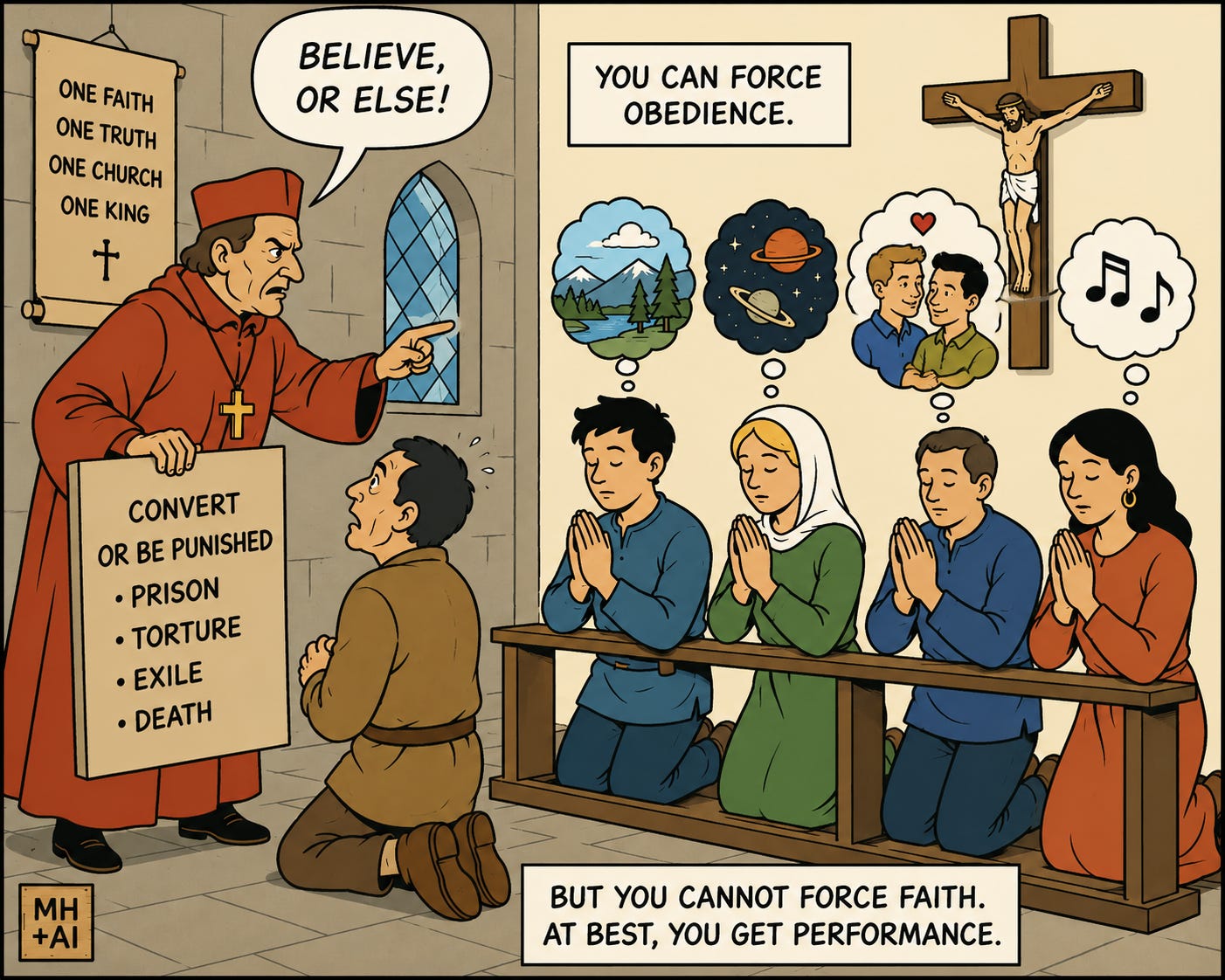
Pope Leo XIV’s historic apology for the Catholic Church’s role in legitimising slavery raises a question that reaches far beyond Christianity. Why have empires, dictators and religious institutions spent centuries trying to force people to believe? Fear can produce obedience, rituals and silence, but it has never produced faith. This column examines the strange history of coercive religion and the even stranger tendency of political power to dress itself in the language of God.
By Mika Horelli, Brussels
I grew up in a Nordic Lutheran culture where religion was rarely loud. People went to church for weddings, funerals and sometimes at Christmas. Faith existed mostly as a quiet background presence. Perhaps that is why I have never fully understood the logic of forcing another human being to believe in God.
This week, Pope Leo XIV did something historically unusual. He apologised openly for the Vatican’s role in legitimising slavery and for centuries of silence surrounding it. The apology itself mattered. Institutions rarely confess willingly that they once sanctified injustice.
The Pope acknowledged that fifteenth-century papal decrees granted European rulers the authority to conquer and enslave “infidels”. One papal bull issued in 1452 explicitly authorised the Portuguese crown to “subjugate” non-Christians and reduce them to perpetual slavery. For centuries, these decrees formed part of the moral architecture of European colonialism.
It was a remarkable moment precisely because it stripped away one of history’s most persistent illusions: the idea that power and faith naturally belong together.
Human beings can be forced to kneel. They cannot be forced to believe.
Power seeks obedience. Faith, at least in theory, seeks conviction. Those are very different things.
That distinction sounds obvious until one examines how much of human history has been built on ignoring it.
For centuries, rulers, churches, and empires behaved as though genuine belief could somehow be extracted through violence, intimidation and fear. Convert or die. Accept the correct doctrine or lose your property. Attend the approved church or become an enemy of the state. Entire civilisations organised themselves around this logic.
The absurdity becomes clearer when reduced to its basic form. If a soldier stands at your door holding a sword and asks whether you believe in the correct God, your answer reveals far more about your desire to stay alive than about your spiritual convictions.
Yet societies repeatedly confuse submission with faith. Or perhaps they did not confuse it at all. Because once religion is viewed not as spirituality but as a technology of power, history suddenly becomes easier to understand.
Empires never needed sincere believers in large numbers. They needed social conformity, predictability and legitimacy. Religion often provided all three at once. A ruler claiming divine authority no longer governed merely through armies or taxation. He governed through eternity itself.
The Catholic Church was hardly unique in this regard. Islamic empires fused political and religious authority for centuries. Protestant Europe persecuted Catholics and vice versa. The Russian Orthodox Church now openly blesses Russia’s invasion of Ukraine as a holy struggle against a decadent West. Hindu nationalism in India increasingly merges religious identity with state power. In Iran, dissent becomes not merely political rebellion but defiance against God.
The methods differ. The logic remains remarkably stable.
Fear creates obedient populations far more reliably than spiritually convinced ones.
What disappears first in such systems is usually not religion but honesty. People learn quickly that survival requires performance. Public rituals multiply. Genuine conviction becomes impossible to distinguish from fear, opportunism or social pressure. Eventually, even leaders themselves begin performing belief theatrically because the system demands it.
The Soviet Union demonstrated the same mechanism in reverse. There, the state attempted to impose atheism with religious intensity. Churches were closed, clergy persecuted, and official ideology elevated into sacred truth. Portraits of Lenin replaced icons; political doctrine replaced theology. The structure remained strangely familiar.
That is because authoritarian systems do not truly care what people believe internally. They care whether citizens publicly comply.
This is also why genuinely religious people often make authoritarian leaders uncomfortable. Real faith entails moral obligations that sometimes take precedence over the state. A sincere Christian may eventually ask inconvenient questions about greed, corruption, cruelty or war. A sincere Muslim may question the injustice committed by rulers claiming divine legitimacy. A sincere believer cannot always be fully controlled.
A frightened conformist is politically safer.
Modern America offers one of the more fascinating examples of religion transforming into political theatre.
The United States remains deeply religious by Western standards. Politicians still speak constantly about God, prayer and Christian values. Public declarations of faith function almost like patriotic rituals. Open atheism remains politically dangerous in presidential politics in ways that would seem bizarre across much of Europe.
And yet much of American political Christianity now appears almost entirely detached from the teachings it claims to defend.
One of the more surreal developments has been the rise of prosperity theology inside American megachurch culture: the idea that wealth itself reflects divine favour. In this interpretation, extreme inequality ceases to be a moral problem and becomes evidence of God’s blessing. Jesus, who spoke repeatedly about poverty, greed and the dangers of wealth, begins sounding less like a religious teacher and more like a celestial business consultant.
In parts of modern American Christianity, Jesus increasingly resembles a brand ambassador for tax cuts and luxury real estate.
From a European perspective, the devotion of parts of the American religious right toward Donald Trump can appear almost surreal. Trump’s public behaviour often seems less like an attempt to follow the Ten Commandments than an attempt to break each of them loudly enough for television cameras to capture the moment properly.
The alliance between sections of the American religious right and Trump remains one of the stranger spectacles of modern democratic politics. A man whose public life has revolved around serial dishonesty, adultery scandals, humiliation rituals, vindictiveness and greed has nevertheless been embraced by millions as a defender of Christian civilisation.
When Pope Leo XIV recently described the war in Iran as the product of a “delusion of omnipotence” leading to “absurd and inhuman violence”, and added that a disciple of Christ “is never on the side of those who once wielded the sword and today drop bombs”, J. D. Vance publicly warned the pontiff to “be careful” and suggested that the Vatican should “stick to matters of morality”.
The phrasing was instructive. A war in which Iranian cities were bombed and civilian infrastructure threatened did not, in Vance’s reading, qualify as a matter of morality at all. The U.S. bishops’ doctrinal office found this awkward enough to issue a public correction, reminding American Catholics that the pope speaking on a war of aggression is not offering an op-ed but exercising his ministry as the Vicar of Christ.
There was something almost darkly amusing in watching an American vice-president lecture the head of the Catholic Church about which subjects Christianity is permitted to cover.
But perhaps this is precisely what happens once religion becomes primarily a tribal identity marker rather than a spiritual discipline.
The language remains religious. The underlying purpose becomes political.
Still, none of this means religion itself is meaningless or fraudulent.
My own grandmothers were quietly religious Lutheran women in Finland. Their faith was never aggressive. They did not attempt to convert strangers or build political movements. Religion gave structure to life and, especially in old age, comfort in the face of death.
I suspect many secular Europeans underestimate how psychologically important that comfort can be.
The promise that death is not final has always been one of humanity’s most powerful ideas.
It is easy to mock such beliefs intellectually. It is much harder to dismiss them sitting beside someone approaching the end of their life.
I have never wanted to take that consolation away from anyone.
Nor do I find it strange that human beings search for meaning beyond themselves. In many ways, it would be stranger if they did not.
What disturbs me is something else entirely: the long historical tradition of using religion as camouflage for domination, cruelty and hypocrisy.
When churches bless slavery, when clerics sanctify invasions, when politicians wrap naked greed in theological language, religion stops functioning as a path toward moral reflection and becomes something much uglier: an instrument for organising obedience.
That is why Pope Leo XIV’s apology mattered. Not because it erased history. It did not. Not because the Catholic Church suddenly became innocent. It never was.
It mattered because institutions built on moral authority rarely admit openly that they once helped legitimise profound injustice. Leo acknowledged that the church took centuries to recognise slavery as fundamentally incompatible with human dignity. He called this “a wound in Christian memory”.
There was something unusually human in that admission.
Especially because the Pope linked that history to artificial intelligence and what he called emerging forms of technological exploitation. His warning was subtle but unmistakable: societies repeatedly justify new systems of domination long before they understand their moral consequences.
History does not repeat mechanically. But it often repeats structurally.
The tools change. The rationalisations evolve. Human beings continue searching for ways to legitimise power.
And perhaps that is why truly sincere believers often remain quieter than those who use religion most loudly in politics. Genuine faith rarely requires armies, censorship or prison sentences to sustain itself.
Fear does.
You can subscribe to the blog directly by email. The blog may be freely shared, and new readers always provide additional motivation to continue writing. I also welcome comments and suggestions about topics you would like me to cover in future columns.